
By hostmyai March 12, 2026
Serverless AI hosting is attractive for a reason. It promises flexible scaling, simpler operations, and the ability to pay for usage instead of always-on capacity.
For teams building chat interfaces, image analysis APIs, document extraction services, recommendation endpoints, or internal copilots, that model can look like the ideal path to fast delivery and lower overhead.
A request comes in after a quiet period, traffic spikes without warning, or a new model version rolls out. Suddenly response time jumps from acceptable to frustrating. What looked like a fast AI endpoint becomes inconsistent, and users feel that inconsistency immediately. In many cases, the culprit is a cold start.
Reducing Cold Starts in Serverless AI Hosting is not just a tuning exercise. It is often the difference between an AI product that feels responsive and one that feels unreliable.
Standard serverless functions already face startup overhead, but AI workloads add heavier runtimes, larger dependencies, model loading time, more memory pressure, and sometimes GPU scheduling. That makes cold start latency much more painful and much harder to ignore.
The good news is that there are practical techniques that work. Teams do not have to accept slow first requests as unavoidable. With better packaging, pre-warming techniques, smarter caching, tuned deployment architecture, and the right hosting model for the workload, serverless AI inference can become far more predictable.
This guide breaks down what cold starts really are, why they hit AI workloads so hard, and how Serverless Cold Start Optimization works in practice. It covers technical causes, proven mitigation techniques, architectural trade-offs, benchmarking methods, common mistakes, and a step-by-step process for improvement.
Whether you are just starting with serverless model serving or already running production AI APIs, the goal is the same: lower latency, better user experience, and scalable infrastructure that does not waste money.
What Cold Starts Mean in Serverless AI Hosting

Cold starts happen when a serverless platform has to create a fresh execution environment before it can process a request.
That environment may need to allocate compute resources, boot a container or microVM, initialize the runtime, load dependencies, establish network connections, and prepare the application code. Only after all of that can the actual AI inference begin.
In a simple function, that delay might be small enough to tolerate. In serverless AI inference, it often becomes much more noticeable. AI functions are rarely lightweight.
They may require model weights, tokenizers, image libraries, vector databases, runtime frameworks, or custom native dependencies. Even when the business logic is simple, the initialization path can be heavy.
This is why Reducing Serverless Cold Starts matters so much for AI teams. Users do not separate startup overhead from processing time. They only experience the final delay. A chatbot that takes several extra seconds on the first message feels broken, even if later requests are faster.
A document processing endpoint that stalls before it starts can disrupt an automated workflow. An image analysis API with unpredictable response times can create poor downstream behavior for every service that depends on it.
Cold starts are also not a one-time event. They can happen repeatedly when traffic is bursty, when instances scale out quickly, when old instances are recycled, or when multiple versions of a model split the traffic pool.
In other words, cold starts do not only affect low-volume applications. They can show up in high-growth environments where scaling behavior constantly creates fresh instances.
Understanding cold starts in practical terms helps teams make better decisions. A cold start is not just “the function is slow.” It is the sum of startup tasks required to get from zero ready capacity to a usable inference environment. Once you view it that way, optimization becomes much more concrete.
Why AI Workloads Feel Cold Starts More Than Standard Functions
A typical event-driven function might parse input, call a service, and return a result. Its startup cost is often limited to loading application code and dependencies. AI workloads usually do much more before they can answer even a single request.
For example, a serverless AI inference endpoint may need to load model files from storage, initialize a tokenizer, allocate large memory buffers, warm up a runtime engine, or download supporting assets at startup.
If the model is image-based, there may be computer vision libraries and pre-processing pipelines involved. If the workload uses embeddings, there may be vector normalization steps and custom libraries. All of that increases model initialization delay.
The performance expectations are also different. AI endpoints are often user-facing. People expect chat responses, classification results, or recommendation calls to return quickly. Even when the total workload is computationally intensive, startup overhead feels especially frustrating because it happens before the “real work” begins.
Another reason cold starts hurt more in AI is that models can be large enough to dominate the response budget. If container spin-up takes a second, dependency loading takes another second, and model loading time takes several more, the final latency can move from acceptable to unusable.
That is why AI Serverless Cold Start Optimization needs to focus not only on platform behavior, but also on how models and runtimes are prepared.
Cold starts are also more damaging in burst traffic scenarios. AI products often see uneven demand. Internal copilots spike during working hours. Customer-facing chat tools spike after notifications or campaigns.
Batch-triggered AI tasks may flood the system at scheduled times. That means autoscaling AI workloads can easily create waves of new cold environments.
Warm Starts vs Cold Starts in Real Usage
A warm start happens when the serverless platform reuses an already initialized execution environment. The container is already running, the runtime is ready, and in many cases the model is already in memory. That is the ideal path for low-latency AI hosting.
Warm starts feel fast because much of the expensive setup work has already been done. The application can move almost immediately to request validation, pre-processing, inference, and response formatting. For many teams, this is the performance profile they see in testing and mistakenly assume will hold under production conditions.
The problem is that real production traffic does not always preserve warm capacity. Idle periods can cause instances to be retired. Rapid demand can create new instances faster than warm ones are available.
Version rollouts, memory pressure, or platform-level balancing can also cause fresh environments to appear. So a system that looks fast during repeated local or staging tests may perform very differently once real traffic patterns hit it.
This is why Serverless Cold Start Reduction should be measured across both warm and cold paths. If you only benchmark repeated calls against one live instance, you are not measuring user reality. You are measuring best-case reuse.
Pro Tip: Always separate warm latency, cold latency, and scale-out latency in your dashboards. They represent different problems and require different fixes.
Why Cold Starts Are a Bigger Problem for AI Than for Typical Serverless Apps

Cold starts are inconvenient in any serverless application, but AI turns inconvenience into a business and product issue. The reason is simple: AI endpoints usually operate within tighter user expectations while carrying heavier initialization burdens.
A simple API may tolerate an occasional first-request delay because the underlying operation is quick and stateless. In contrast, AI workloads often sit behind interactive products where speed shapes trust. A customer-facing assistant that pauses before answering can feel unreliable.
A search assistant that adds several seconds to retrieval and generation may ruin the flow of the experience. A fraud screening function that delays a transaction workflow may affect conversion or operational efficiency.
The technical profile makes the problem worse. AI services frequently use large model files, high-memory runtimes, specialized libraries, GPU-backed inference environments, and extra pre-processing or post-processing logic.
Even small models can carry significant startup overhead if they rely on heavy frameworks or bloated containers. For larger models, cold start latency can dwarf the actual inference call.
This is where Serverless Performance Optimization for AI becomes less about generic best practices and more about workload-aware design. Teams need to consider request frequency, concurrency patterns, model size, endpoint sensitivity, and traffic burstiness together. Cold starts are not just a platform artifact. They are a direct reflection of how the AI stack is packaged and deployed.
The impact also spreads beyond user experience. Longer startup delays can break queues, increase retries, create timeout cascades, inflate compute waste, and complicate autoscaling policies. When one cold start leads to client retries or duplicate event handling, the cost and operational impact go well beyond a single slow request.
User Experience Damage Shows Up Fast in AI Products
AI products are often judged in the first few seconds. A conversational assistant, a content classifier, or an image tagging service does not get much patience from users. If the first request stalls, many users assume the tool is unstable, not merely warming up.
This is especially true in real-time AI inference use cases. Think about live support copilots, interactive recommendation systems, moderation endpoints, or product search enhancements.
These are systems where delays interrupt a larger interaction. Even if the model output quality is strong, poor response timing can make the product feel worse than a simpler but faster alternative.
Latency inconsistency is often more damaging than steady latency. Users can adapt to a product that always takes a known amount of time. They struggle with a product that sometimes responds quickly and sometimes pauses unpredictably. Cold starts create exactly that inconsistency.
For technical decision-makers, this means performance budgets should include startup overhead as a first-class concern. An endpoint that averages fast responses but has painful outliers may still fail the product requirement. Reducing Serverless Cold Starts is often about tightening the latency distribution, not only lowering the average.
Infrastructure Side Effects Can Be Expensive
Cold starts are not just a latency issue. They can increase cost and complexity in subtle ways. When a cold instance takes too long, clients may retry. Retries can trigger more scale-out. More scale-out creates more cold instances. This feedback loop can turn one traffic burst into a larger operational problem.
AI workloads also tend to be heavier consumers of memory and storage bandwidth during initialization. If several new instances launch together and all pull the same model artifacts, storage systems can become a bottleneck.
That introduces extra network delays and further increases startup overhead. In extreme cases, the startup path becomes the system’s weakest link.
There is also the cost of overcompensation. Teams that struggle with cold starts often jump to keeping everything warm all the time. That can work, but it may erase the cost advantages of serverless. Provisioned concurrency, pre-warmed pools, and dedicated capacity all improve responsiveness, yet they must be used carefully or the bill grows quickly.
A strong Serverless Cold Start Optimization strategy balances speed and efficiency. The aim is not to eliminate every cold start at any cost. It is to reduce their frequency and impact enough to meet service goals while preserving the scalability benefits that made serverless appealing in the first place.
AI Workloads Have More Startup Stages Than Most Teams Expect
One reason teams underestimate the issue is that cold starts are often treated as a single number. In practice, it is several stages stacked together. The platform allocates resources. The container starts. The runtime initializes. Dependencies load. The model becomes available. External services connect. Only then does inference begin.
Each stage can behave differently across languages, frameworks, model types, and deployment choices. A team may optimize container startup optimization but still suffer slow model loading time.
Another team may trim dependencies and still lose time to network-attached model storage. A third may solve CPU-based cold starts while GPU-backed inference remains unpredictable due to scheduling or provisioning behavior.
Breaking startup into stages is one of the most useful habits in AI Serverless Cold Start Optimization. It helps teams stop treating latency as mysterious and start treating it as measurable engineering work.
The Most Common Causes of Cold Starts in Serverless AI Hosting
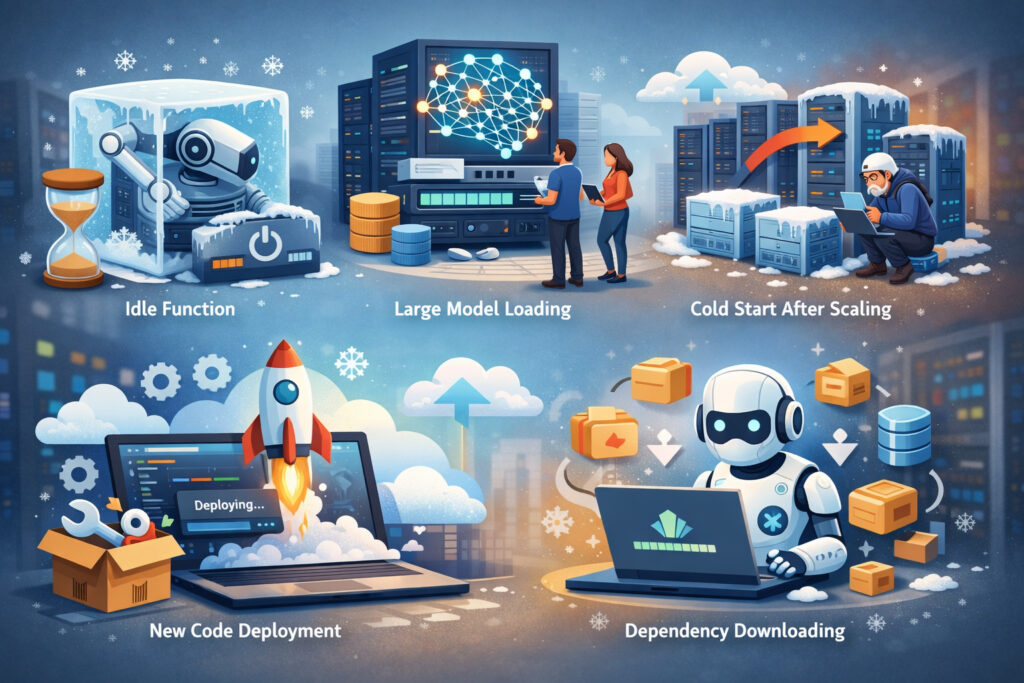
To reduce cold starts, you need to understand what creates them. In serverless AI hosting, the delay usually comes from a combination of platform behavior and application design.
Some causes are external to the function, such as compute allocation or infrastructure scaling behavior. Others come directly from the AI stack, such as model packaging optimization, runtime choice, or dependency size.
The biggest mistake teams make is assuming cold start latency is caused by only one factor. In reality, most slow starts come from several bottlenecks layered together.
A platform may spend time creating an execution environment, while the function then spends more time unpacking dependencies and pulling a model artifact over the network. If each step is only moderately slow, the total experience can still become unacceptable.
This is why Serverless Cold Start Reduction needs a whole-path view. You are not just tuning code. You are tuning the journey from “no active instance” to “ready to serve inference.” Every unnecessary startup task adds friction, and AI workloads tend to accumulate many of them.
Container Spin-Up and Runtime Initialization
The first stage in many serverless environments is creating the execution environment itself. Depending on the platform, this could involve container startup, microVM initialization, filesystem setup, sandboxing, and runtime bootstrapping. Even before your application code runs, time is already being spent.
Runtime initialization can add a surprising amount of overhead. Some runtimes boot faster than others. Framework-heavy applications may execute significant setup logic at import time.
Large dependency trees can force longer load phases before the handler is even ready. If a framework performs validation, scans modules, or eagerly initializes services during startup, cold start latency rises fast.
For AI functions, this stage often overlaps with native libraries for inference frameworks, image processing, tokenization, or numerical computation. Loading those libraries can be expensive, especially when the deployment package includes many components that are not needed for every request.
Teams focused on Minimize Cold Starts in Serverless Functions should pay attention to what happens before business logic begins. The fastest handler in the world will not help if the environment and runtime need several seconds to become usable. Faster runtimes, smaller startup paths, and lazy initialization patterns can make a meaningful difference here.
Model Loading Time and Dependency Size
In serverless AI inference, model loading time is often the largest single contributor to cold start latency. A function may need to download model weights, deserialize them, allocate tensors, initialize a runtime engine, and place the model into memory before it can process anything. If the model is large, or the storage path is slow, this becomes a major bottleneck.
Dependency size adds to the problem. Many AI deployments carry frameworks, utility libraries, preprocessing packages, and optional extras that dramatically increase package size without improving the request path.
Large packages take longer to transfer, unpack, mount, and import. They also create more work for security scanning and startup filesystem operations in some environments.
This is where model packaging optimization matters. A poorly packaged model can make a compact inference task behave like a heavyweight batch job.
Teams often ship full training-oriented dependencies into inference environments, even though the endpoint only needs a small serving subset. Others include multiple model variants in one image when only one is used at runtime.
AI Serverless Cold Start Optimization often starts with asking a hard question: what absolutely must be present at startup for this endpoint to answer the first request? Everything else should be deferred, removed, cached, or split out.
Network Delays and Remote Asset Fetching
Cold starts get worse when critical assets live on remote storage and must be fetched before the function becomes ready. That can include model files, tokenizer data, configuration bundles, feature dictionaries, or certificate chains. Even if each network request is individually fast, startup can degrade when several are chained together.
Remote fetching also introduces variability. Network latency can change under load. Object storage throughput may dip during burst traffic. DNS resolution, TLS negotiation, and authentication flows can each add overhead. A startup path that looks acceptable in isolated testing may become unstable when many cold instances fetch the same resources at once.
For serverless model serving, this is a crucial architectural consideration. Keeping everything out of the deployment package sounds attractive because it reduces image size, but externalizing too much can simply move the latency elsewhere. There is a trade-off between lean packaging and excessive startup dependency on remote services.
A more resilient approach is often selective embedding plus smart caching. Keep the truly essential small assets local to the image, cache reusable model components where possible, and avoid making the first request responsible for assembling half the runtime environment from scratch.
Infrastructure Scaling Behavior and Burst Traffic Handling
Cold starts are tightly connected to autoscaling. When demand rises beyond current warm capacity, the platform creates new instances. For many AI services, this happens during exactly the moments when latency matters most: burst traffic, live campaigns, queue surges, internal workflow peaks, or rapid user adoption events.
Infrastructure scaling behavior can be especially tricky because it is not just about whether scaling occurs, but how quickly usable instances can be created.
With AI workloads, there is a difference between “more containers were launched” and “more inference-ready endpoints are available.” If each new instance needs heavy initialization, scaling may lag behind the incoming request rate.
This is why Serverless Cold Start Optimization should account for traffic shape, not just average volume. An endpoint that serves steady traffic well may still fail during bursts because the scale-out path is too slow. Low-latency AI hosting requires understanding how the platform behaves when warm capacity runs out.
Teams often underestimate the impact of scale fragmentation too. Multiple models, multiple versions, and many route-specific endpoints can divide traffic into smaller pools, which reduces instance reuse and makes cold starts more frequent. Sometimes the issue is not insufficient scale. It is an over-segmentation of the serving architecture.
Practical Techniques That Reduce Cold Starts in Serverless AI Hosting
There is no single fix for cold starts in AI hosting. Effective Serverless Cold Start Reduction comes from combining several techniques that address different stages of startup. Some reduce the number of cold starts. Others reduce the duration of each one. The strongest results usually come from doing both.
For teams serious about Reducing Cold Starts in Serverless AI Hosting, the most valuable mindset shift is this: treat cold start optimization as product engineering, not just infrastructure tuning.
The right solution depends on how users interact with the AI system, how often traffic arrives, how large the models are, and what latency targets matter most.
Below are the techniques that consistently deliver practical gains.
Provisioned Concurrency and Always-Ready Capacity
Provisioned concurrency is one of the most direct ways to reduce cold starts. Instead of waiting for the platform to create environments on demand, you keep a certain number of instances initialized and ready to serve requests. For latency-sensitive AI endpoints, this can dramatically reduce first-request delays.
This technique works especially well for predictable workloads. If you know traffic peaks during certain hours or after certain events, you can maintain warm capacity during those windows and scale it down later.
It is also useful for customer-facing AI tools where the first interaction must feel responsive, such as chat assistants, moderation APIs, or interactive search enhancement.
The trade-off is cost. Provisioned concurrency moves you closer to paying for readiness instead of just usage. That is not inherently bad. In fact, it may be the correct choice if response quality and user trust matter more than maximum cost efficiency.
The key is to right-size it. Keep enough warm capacity for expected demand, then let burst scaling handle the rest.
For Serverless Performance Optimization for AI, provisioned concurrency is often best used selectively. Protect the most latency-sensitive endpoints and the most common models first. Do not assume every background AI task needs always-ready capacity.
Pre-Warming Techniques and Scheduled Warm-Up Strategies
Pre-warming techniques aim to reduce startup delays by triggering functions before real traffic arrives. This can be done through scheduled invocations, synthetic traffic, health pings, or event-based warming after deployments. The goal is to keep execution environments alive and models resident in memory.
Pre-warming is popular because it can be simpler than provisioning dedicated warm capacity. It works best for workloads with known idle windows and known activity patterns.
For example, an internal copilot used heavily during working hours may benefit from timed warm-up triggers before peak periods begin. A document processing service may pre-warm just before expected batch submissions.
That said, pre-warming is not magic. It may not keep enough instances alive during rapid scale-out. Some platforms recycle environments despite light traffic.
Synthetic warming can also create noise in observability data if not labeled properly. And warming too aggressively can waste money without guaranteeing real readiness when demand arrives.
The smart use of pre-warming in AI Serverless Cold Start Optimization is targeted and measured. Use it where traffic patterns are somewhat predictable, where cold starts are clearly harmful, and where warm environments can meaningfully reduce model initialization delay.
Model Packaging Optimization and Dependency Trimming
One of the most effective ways to reduce cold start latency is to make the thing being started smaller and simpler. Model packaging optimization means shipping only what the inference endpoint truly needs. Dependency trimming means removing everything else.
This sounds obvious, but many deployments violate it badly. Teams often package full development environments into serverless containers.
They include training libraries, debugging tools, unused tokenizer assets, alternative model versions, or broad utility packages that are never touched during inference. All of that increases startup overhead.
A tighter package leads to faster transfer, mounting, import time, and initialization. It can also improve memory behavior and reduce the chance of platform-level resource contention. In some cases, converting models into more efficient runtime formats or smaller inference-optimized artifacts can significantly reduce load time.
For serverless model serving, packaging decisions should be made with startup in mind. Ask whether you can strip unnecessary files, split heavyweight utilities into separate services, lazy-load secondary components, or move rarely used logic out of the hot path. These changes often produce larger gains than teams expect.
Pro Tip: Audit your production image like a shipping budget. If a file, framework, or library does not improve the first successful inference, it should be questioned.
Optimized Containers, Faster Runtimes, and Startup-Aware Code
Container startup optimization matters because every second spent before the model loads is a second the user still waits. Smaller base images, cleaner layers, fewer startup hooks, and reduced filesystem work can all make startup faster. Choosing a runtime with quick initialization characteristics can also help.
But infrastructure choices alone are not enough. Application startup logic matters just as much. Avoid eager loading of optional services. Delay initialization of secondary clients until first use.
Cache expensive objects inside the warm instance when possible. Do not perform full environment scans or broad configuration loading during each cold start unless truly necessary.
Startup-aware code is especially important for AI inference APIs. Some teams unknowingly do work at startups that belong elsewhere, such as model validation routines, heavy telemetry setup, or external configuration discovery that could have been resolved during build or deploy time. Others initialize multiple models when requests only use one.
Reducing Serverless Cold Starts often comes down to ruthless discipline: make the initial code path do less. A serverless AI endpoint should become inference-ready as quickly as possible, then perform additional work only when necessary.
Advanced Strategies for Different AI Workloads
Not all AI workloads behave the same way. The right optimization strategy depends on model size, inference hardware, request pattern, and latency expectations. What works for a lightweight text classifier may not help a large multimodal model. A GPU-backed inference service has very different cold start behavior than a compact CPU-based endpoint.
That is why AI Serverless Cold Start Optimization must be workload-specific. Teams get better results when they stop applying generic serverless advice to every model equally. The real question is not “How do we reduce cold starts?” but “How do we reduce cold starts for this type of AI workload without breaking cost, maintainability, or scaling?”
Large Models vs Lightweight Models
Large models magnify every startup problem. Their artifacts take longer to move and load, they require more memory, and they often depend on heavier runtimes. Even with optimized packaging, model initialization delay can remain substantial.
For these workloads, the strongest gains often come from architectural choices rather than minor code tweaks.
Provisioned concurrency, model sharding strategies, persistent warm pools, or even moving away from pure serverless may be necessary for truly low-latency use cases.
Large models that power interactive experiences are often better suited to hybrid architectures where baseline capacity stays warm and serverless handles overflow or asynchronous tasks.
Lightweight AI models are different. Smaller classifiers, compact embedding models, distilled NLP models, and narrow computer vision models can fit much better into serverless patterns.
These workloads are more likely to benefit from aggressive dependency trimming, optimized runtimes, edge AI deployment, and pre-warming. Their cold starts can often be reduced enough to support real-time AI inference affordably.
The lesson is practical: use serverless where the model profile supports it. Do not force a large-model serving problem into a lightweight-function mindset.
CPU-Based Inference vs Serverless GPU Workloads
CPU-based inference is usually easier to run in serverless environments because the infrastructure is more common and startup paths are simpler. Small to medium models performing classification, extraction, routing, recommendation, or lightweight generation can often reach acceptable latency with standard Serverless Cold Start Optimization techniques.
Serverless GPU workloads are more complex. GPU-backed inference may involve limited regional availability, longer hardware provisioning times, larger container images, and runtime stacks that take longer to initialize.
If the platform provides GPUs on demand, cold starts can become especially painful. Even when the container launches quickly, actually getting the model loaded onto GPU memory can take significant time.
This does not mean serverless GPU workloads are a bad idea. They can be useful for bursty jobs, specialized image processing, or spiky inference demand. But teams should set expectations carefully. For interactive low-latency endpoints, relying on cold GPU startup can be risky. Pre-allocated warm capacity or hybrid routing often makes more sense.
When evaluating Serverless Performance Optimization for AI on GPUs, measure not only request latency but also queue wait time, hardware assignment delay, and model-on-device readiness. Those hidden stages often explain why “it scales” is not the same as “it responds quickly.”
Single-Model Endpoints vs Multi-Model Deployments
Multi-model deployments can improve infrastructure efficiency, but they often complicate cold start behavior. If one endpoint can serve several models, startup may involve loading routers, registries, shared dependencies, and model selection logic.
If models are loaded on demand, first request latency can spike unpredictably depending on which model is requested.
Single-model endpoints are simpler to tune because the startup path is narrower and more predictable. You know which assets are needed and can optimize directly for that model. Warm instance reuse is also cleaner when all traffic targets the same inference path.
That said, multi-model serving can still work well if designed carefully. Popular models can remain preloaded while less common ones load lazily.
Routing layers can direct high-volume traffic to specialized endpoints and long-tail traffic to shared infrastructure. Caching can help prevent repeated model initialization for frequently requested variants.
The decision should follow traffic reality. If several models each receive enough demand to justify dedicated warm capacity, separate them. If long-tail traffic is sparse, a shared service may be more efficient even with occasional cold penalties. The goal is thoughtful Serverless Cold Start Reduction, not architectural purity.
Pro Tip: Split high-frequency and low-frequency models into different serving paths. The best way to protect the hot path is often to stop making it share infrastructure with cold paths.
Architectural Patterns That Minimize Cold Starts Without Losing Scalability
Reducing startup overhead is important, but it is only part of the bigger design problem. Teams also need architectures that remain maintainable, scalable, and cost-aware over time.
It is easy to cut latency by keeping everything always on. It is much harder to do that while preserving the flexibility that makes serverless attractive.
The strongest architectures for low-latency AI hosting usually combine multiple patterns. They use serverless where elasticity is valuable, reserved warm capacity where latency is critical, caching where repeat work is common, and asynchronous flows where real-time responses are not necessary. This is how teams Minimize Cold Starts in Serverless Functions without creating brittle systems.
Split Interactive and Background AI Workloads
One of the cleanest architectural improvements is separating low-latency user-facing requests from event-driven AI tasks. Interactive endpoints such as chatbots, AI APIs, moderation checks, search ranking helpers, or internal copilots usually need tight latency budgets. Background jobs such as bulk document processing, asynchronous summarization, or offline enrichment do not.
When both classes of work run through the same serverless design, the system often ends up optimized for neither. Interactive traffic suffers because the environment is built for flexible throughput rather than low-latency readiness. Background work becomes more expensive because capacity is tuned for response speed instead of throughput.
A split architecture helps. Keep customer-facing or operator-facing endpoints on warmer, more predictable paths. Use queues, event triggers, or serverless batch patterns for work that can tolerate startup overhead. This separation also makes performance testing easier because each path has clearer service expectations.
For Reducing Cold Starts in Serverless AI Hosting, workload separation is often more impactful than a dozen micro-optimizations in one overloaded function.
Use Caching at Multiple Layers
Caching is not only for outputs. Inference caching, model caching, preprocessed asset caching, and connection reuse can all lower effective cold start cost.
If repeated requests produce the same or similar outputs, caching at the API or application layer can avoid unnecessary model invocations entirely. If models or tokenizers can remain cached across warm requests, startup work does not need to repeat.
Teams should think in layers. Cache frequent prompts or repeated query results where safe. Cache embeddings for recurring documents or phrases. Cache tokenizer assets and preprocessing artifacts locally inside warm environments. Cache network connections and authenticated clients so they do not reinitialize on each request.
Caching does not eliminate true cold starts, but it reduces how often the full expensive path must be traversed. It also helps serverless AI inference remain efficient when traffic contains repetition, which is common in internal tools, search workflows, and classification services.
The caution is correct. Cache only where business logic allows it, use proper invalidation strategies, and avoid stale outputs in dynamic contexts. Done well, caching is one of the most practical forms of startup overhead reduction available.
Hybrid Deployment Models Often Win
Many teams eventually discover that the best answer is not fully serverless or fully container-based.
It is hybrid. In a hybrid model, predictable baseline traffic goes to warm container-based services or reserved serving pools, while bursty overflow or lower-priority work goes to serverless endpoints. This preserves elasticity without making every request pay cold start risk.
Hybrid deployment models are especially effective when traffic is uneven. For example, a chatbot may have a steady baseline of interactive requests and unpredictable bursts during promotions or product launches.
Keeping a warm baseline path active protects the user experience, while serverless handles overflow without requiring permanent overprovisioning.
Hybrid design is also helpful when model sizes differ. Lightweight models can remain serverless, while heavier models or GPU-heavy tasks use dedicated services. Internal tools can use serverless for development and moderate usage, then graduate hot paths to container-based serving when latency or consistency becomes more important.
Choosing between serverless, container-based, and hybrid deployment models should follow workload goals, not platform preference. The best architecture is the one that gives the required AI inference performance at a sustainable operating cost.
Observability, Benchmarking, and Performance Testing for Cold Start Reduction
You cannot improve what you do not measure, and cold starts are often measured poorly. Many teams rely on average response times or simple request logs, which hide the startup behavior that actually shapes user experience. Proper observability is essential for meaningful Serverless Cold Start Optimization.
The right measurement strategy separates warm performance from cold performance, tracks scale-out behavior, and identifies which phase of startup is responsible for the delay. Without that visibility, teams may waste time optimizing inference code when the real bottleneck is model download, container startup, or dependency import time.
Strong observability also helps with cost control. When you know how often cold starts occur, how long they last, and which endpoints are affected most, you can decide where provisioned concurrency or pre-warming is actually worth paying for.
What to Measure Beyond Average Latency
Average latency is one of the least helpful metrics for cold start analysis because it smooths away outliers. AI endpoints can look healthy on average while still failing real users during cold or scale-out requests. You need distribution-aware metrics.
Useful measurements include:
- Cold start rate by endpoint
- Warm start latency vs cold start latency
- p95 and p99 response times
- Startup stage timing, such as container init, dependency load, and model load
- Time to first token or first meaningful output for generative flows
- Queue time before execution begins
- Scale-out response degradation during bursts
- Error and retry rates linked to slow starts
It is also worth tagging metrics by deployment version, model version, runtime, and traffic source. Cold start behavior often changes after a deployment, after package growth, or when new models are introduced. Without that context, the numbers can be hard to interpret.
For Serverless Performance Optimization for AI, instrumentation should follow the actual inference lifecycle. The more precisely you can see where latency lives, the less guesswork your optimization work requires.
How to Benchmark Cold Starts Realistically
Cold start benchmarking must reflect production patterns. Repeatedly calling the same endpoint with short intervals is useful for warm testing, but it does not tell you much about cold behavior. Realistic tests include idle gaps, burst traffic, concurrent first requests, and version rollouts.
A good benchmark plan often includes three scenarios. First, true cold starts after idle periods. Second, warm path latency under steady load. Third, scale-out performance under burst conditions. These scenarios reveal different weaknesses and should be compared before and after each optimization change.
It is also important to test with real model artifacts and production-like dependencies. Synthetic toy models can create false confidence because they do not represent actual model loading time, memory pressure, or dependency complexity.
Likewise, benchmarking in a narrow staging environment may miss the network and storage behavior seen under real traffic.
Use Observability to Guide Iteration, Not Just Reporting
Observability is most useful when it helps teams decide what to change next. If cold starts mostly come from model download, then provisioning more warm instances may not be the first fix.
If the runtime imports huge dependency trees at startup, model compression alone will not solve the main delay. If burst traffic overwhelms warm pools, then traffic shaping or hybrid scaling may matter more than shaving a few milliseconds from code import.
That is why dashboards should not only show top-line latency. They should tell a causal story. Which endpoints suffer most? Which models cause the slowest startup? Which changes improved p95 response time? Where are retries or timeout errors linked to cold environments?
For teams already running production serverless model serving, this level of visibility turns cold start reduction into an ongoing engineering practice rather than a one-time cleanup project. That is the difference between chasing symptoms and building a durable performance culture.
Practical Use Cases and What Works in Each One
Cold start optimization becomes much easier when you ground it in actual use cases. Different AI applications have different latency budgets, concurrency patterns, and user expectations.
A strategy that works for batch document processing may fail for a live chatbot. A pattern that makes sense for image analysis may be unnecessary for an internal recommendation service.
Thinking by use case helps teams choose the right level of investment in Reducing Serverless Cold Starts.
Chatbots, AI APIs, and Low-Latency Customer-Facing Tools
Interactive tools need the strongest protection from cold starts. Chatbots, search assistants, smart routing APIs, agent copilots, and personalized user experiences are all judged by responsiveness.
In these cases, provisioned concurrency, targeted pre-warming, inference caching, and warm baseline capacity are often worth the cost.
Lightweight models work especially well in serverless settings for this category. Distilled intent classifiers, routing models, sentiment checks, guardrails, or compact embedding services can often achieve good latency with careful packaging and caching.
Larger generation models may need hybrid serving, where a warm pool handles the primary path and serverless handles overflow or non-critical requests.
Keep the request path narrow. Preload only the most-used assets. Cache recurring results where allowed. Use edge AI deployment for simple logic near the user when that meaningfully reduces round-trip time. For low-latency customer-facing AI tools, consistency matters as much as peak speed.
Image Analysis Endpoints and Document Processing Services
Image analysis can vary widely. Small classification or moderation models may perform well in serverless environments with optimized images and compact runtimes. Heavier object detection or multimodal pipelines may struggle if the models are large and the pre-processing stack is heavy.
Document processing is often a good fit for event-driven serverless AI tasks because many workflows are asynchronous by nature. Optical extraction, summarization, categorization, and metadata enrichment often happen behind the scenes. That means cold starts matter less than throughput, cost efficiency, and reliable scaling.
Still, cold starts can impact these systems when queue backlogs build or when upstream workflows expect quick acknowledgment. For document processing, workload splitting is powerful.
Handle lightweight validation or routing in fast serverless functions, and send heavyweight extraction or analysis to longer-running workers or container-based services. This preserves elasticity while avoiding cold-start-heavy monoliths.
Internal Copilots and Bursty Knowledge Tools
Internal copilots often have highly bursty traffic. Usage spikes around work sessions, meetings, ticket review times, and operational peaks. There may be long quiet periods followed by concentrated bursts from many users. This makes them classic cold-start risk candidates.
Scheduled pre-warming is often effective here because activity windows are somewhat predictable. Inference caching can also help because internal queries and reference patterns tend to repeat.
If the tool relies on multiple models, route common tasks through a warm lightweight path and reserve heavier models for less frequent operations.
For internal tools, cost sensitivity is often balanced differently than in customer-facing products. Teams may accept slightly slower responses if usage is moderate, but they still need reliability. The right design usually combines selective warming, smarter routing, and realistic observability rather than maximum always-on capacity.
Common Mistakes That Make Cold Starts Worse
Many cold start issues are self-inflicted. Teams often assume the platform is the problem when the deeper issue is packaging, architecture, or workload mismatch. Avoiding a few common mistakes can produce faster improvements than chasing platform-specific tuning first.
Oversized Packages, Unnecessary Model Loads, and Ignored Caching
One of the biggest mistakes is shipping oversized deployment packages. If your inference function includes unused frameworks, extra model files, development tools, or broad utility bundles, you are paying for that bloat at startup. Serverless Cold Start Reduction begins with removing what is not needed.
Another common mistake is loading the full model or full pipeline when only a small part is necessary for many requests. For example, a service may initialize multiple model heads, extra preprocessing paths, or fallback assets that are rarely used. That turns every cold start into a worst-case path.
Ignoring caching is equally costly. Teams sometimes recompute embeddings, reload tokenizers, or repeat the same model setup work because the architecture was built for correctness but not reuse. Inference caching and warm-instance reuse are major tools for startup overhead reduction, yet they are still underused.
Underestimating Traffic Spikes and Choosing Serverless for the Wrong Workload
Some teams size their architecture based on average traffic and then get surprised when burst traffic handling reveals a cold start problem.
AI demand is often uneven. New launches, internal usage waves, scheduled jobs, and event-driven flows can all create sudden scale-out. If you design only for steady state, cold starts will show up at the worst time.
Another mistake is choosing serverless for workloads that do not fit it well. Very large models, strict ultra-low-latency requirements, or heavy GPU dependence may point toward container-based or hybrid approaches from the start. Serverless can still play a role, but not necessarily as the primary serving layer.
This is not a failure of serverless. It is a workload selection issue. Good infrastructure design starts with matching the hosting model to the AI behavior you actually need.
Pro Tip: If your endpoint cannot tolerate cold start penalties and the model takes substantial time to become inference-ready, treat pure serverless as an assumption to test, not a default to defend.
A Step-by-Step Checklist for Improving Serverless AI Performance Over Time
Reducing cold starts is most effective when handled as an ongoing process. Teams that improve steadily usually follow a sequence rather than trying random fixes.
Step 1: Measure the Real Problem
Start by separating warm and cold latency. Measure cold start rate, p95 and p99 performance, model load time, runtime init time, and scale-out behavior. Identify which endpoints actually suffer and how often.
Step 2: Trim What You Ship
Reduce dependency size. Remove unused libraries. Strip development artifacts. Package only the required model files and serving assets. Tighten the startup path until the function contains only what the hot path needs.
Step 3: Optimize Initialization Logic
Move nonessential work out of startup. Lazy-load optional resources. Reuse clients and cached assets inside warm instances. Avoid broad import-time initialization that delays the first request.
Step 4: Add Caching Where It Helps
Use inference caching, preprocessed asset caching, tokenizer reuse, and local warm-instance caches when safe. Eliminate repeated work that does not need to happen on every request or every startup.
Step 5: Protect Latency-Sensitive Endpoints
Apply provisioned concurrency or selective pre-warming to the endpoints where cold starts hurt most. Focus on customer-facing AI tools and the highest-value request paths first.
Step 6: Adapt Architecture to Workload Type
Split background and interactive flows. Separate high-volume models from long-tail models. Consider hybrid deployment architecture when serverless alone cannot meet latency goals.
Step 7: Test Under Realistic Conditions
Benchmark true cold starts after idle periods. Test bursts and concurrent scale-out. Compare improvements using repeatable scenarios, not only steady-state load tests.
Step 8: Revisit the Hosting Model Regularly
As traffic grows, model complexity changes, or latency expectations tighten, reassess whether the current deployment model still fits. What works in early rollout may need to evolve in production.
This checklist helps both new teams and mature teams. Early-stage builders can use it to avoid painful design choices. Production teams can use it to reduce regressions and keep serverless AI inference performance aligned with product needs.
FAQ
Q.1: What is a cold start in serverless AI hosting?
Answer: A cold start happens when a serverless platform needs to create a new execution environment before serving an AI request. That can include container startup, runtime initialization, dependency loading, and model loading. In AI workloads, this often causes noticeable delays because the startup path is heavier than in standard functions.
Q.2: Why are cold starts worse for AI workloads?
Answer: AI workloads often require large dependencies, model files, tokenizer assets, numerical libraries, and more memory during startup. Some also involve GPU-backed inference or remote model fetching. That means cold start latency can be much longer than in ordinary serverless applications.
Q.3: What is the best way to reduce serverless cold starts for AI APIs?
Answer: The most effective strategy is usually a combination of techniques. Start with dependency trimming, lighter model packaging, and startup-aware code. Then add provisioned concurrency or pre-warming for the most latency-sensitive endpoints. Caching and hybrid deployment patterns often help as well.
Q.4: Can pre-warming completely eliminate cold starts?
Answer: Not always. Pre-warming can reduce the chance of cold starts and lower their impact, but it may not cover sudden burst traffic or all platform recycling behavior. It works best when paired with observability, realistic traffic planning, and selective always-ready capacity.
Q.5: Is serverless a good fit for all AI inference workloads?
Answer: No. Lightweight models, event-driven AI tasks, and bursty moderate-latency workloads often fit well. Very large models, strict real-time requirements, or heavy serverless GPU workloads may perform better with container-based or hybrid deployment models.
Q.6: How do I know whether cold starts are hurting my AI application?
Answer: Look at p95 and p99 latency, first-request delays after idle periods, scale-out performance during traffic spikes, and retry or timeout patterns. If users experience unpredictable latency or if startup time makes up a large portion of total response time, cold starts are likely a meaningful issue.
Q.7: What are common mistakes in Serverless Cold Start Optimization?
Answer: Frequent mistakes include oversized deployment packages, loading full models unnecessarily, ignoring caching opportunities, testing only warm performance, underestimating burst traffic handling, and using serverless for AI workloads that need more persistent warm capacity.
Q.8: What is the difference between warm starts and cold starts?
Answer: A warm start reuses an already initialized environment where the runtime and often the model are already loaded. A cold start creates a fresh environment from scratch. Warm starts are usually much faster and more consistent.
Q.9: Should I choose serverless, containers, or a hybrid model for AI hosting?
Answer: That depends on your workload. Choose serverless when elasticity and operational simplicity matter and cold start reduction can bring latency within acceptable limits. Choose containers when you need consistently warm, predictable performance. Choose hybrid when you want warm baseline performance with elastic overflow capacity.
Conclusion
Reducing Cold Starts in Serverless AI Hosting is not about chasing perfection. It is about making AI systems responsive enough, consistent enough, and efficient enough to serve real users and real business workflows well.
Cold starts become a bigger issue in AI because the startup path is heavier. Models need loading. Dependencies are larger. Initialization is more complex. Bursty traffic is common.
For that reason, Serverless Cold Start Optimization must go beyond generic function tuning. It needs workload-aware design, smarter packaging, better caching, clearer observability, and, sometimes, a willingness to use hybrid serving instead of pure serverless.
The techniques that work are practical. Trim dependencies. Optimize containers. Reduce model loading time. Use provisioned concurrency where latency matters. Apply pre-warming techniques where traffic is predictable.
Split interactive and background workloads. Cache aggressively but carefully. Benchmark cold, warm, and scale-out paths separately. Most importantly, match the hosting model to the actual AI workload instead of forcing every endpoint into the same pattern.
For some teams, the right answer will be a lightweight serverless model serving with careful warm-up. For others, it will be a hybrid architecture that keeps the hot path warm and lets serverless absorb bursts. For others still, large-model or GPU-heavy inference may belong on more persistent infrastructure.
The winning approach is the one that meets performance goals without losing operational sanity. That is the real promise of Serverless Performance Optimization for AI: not theoretical efficiency, but dependable AI experiences at scale.